Air brakes are the standard braking system on every Class A commercial vehicle in Canada. Unlike the hydraulic brakes in your car, air brakes use compressed air stored in tanks to apply friction to the wheels, and they fail safe, meaning they engage automatically when air pressure drops too low. Understanding the system is non-negotiable for A drivers.
The Three-Part System
Every air brake system has three core circuits: the supply system, the service brake system, and the parking/emergency brake system. Each has its own air tank, and each protects the others through one-way valves so a failure in one doesn't cascade.
Key Components You'll Be Tested On
- Air compressor, driven by the engine, fills the supply tanks
- Governor, controls when the compressor cuts in and out (typically 100 PSI cut-in, 125 PSI cut-out)
- Air dryer, removes moisture before it reaches the tanks
- Service brake chambers, push the slack adjusters when you press the pedal
- Spring brakes, the parking brake; engages when air pressure drops
- Slack adjusters, convert linear push into rotation that applies the brakes
The Air Brake Test Sequence
Every pre-trip inspection includes a full air brake test. The sequence is fixed and the examiner will be listening for you to verbalize each step.
- Charge the system to full pressure (around 125 PSI)
- Turn off the engine, release service brakes, watch for less than 3 PSI loss in 1 minute
- Apply service brakes fully and held, watch for less than 4 PSI loss in 1 minute
- Pump the brakes until the low-air warning activates (around 60 PSI)
- Continue pumping until spring brakes apply automatically (around 20-45 PSI)
Why The 'Stab Brake' Technique Matters
If your trailer ever begins to skid on a slick surface, the right response is short, firm pedal applications, not a single hard press. Each stab lets the wheels regain traction momentarily before the next application. Modern ABS-equipped trucks handle some of this automatically, but the technique is still in the curriculum because it works on any system, ABS or not.
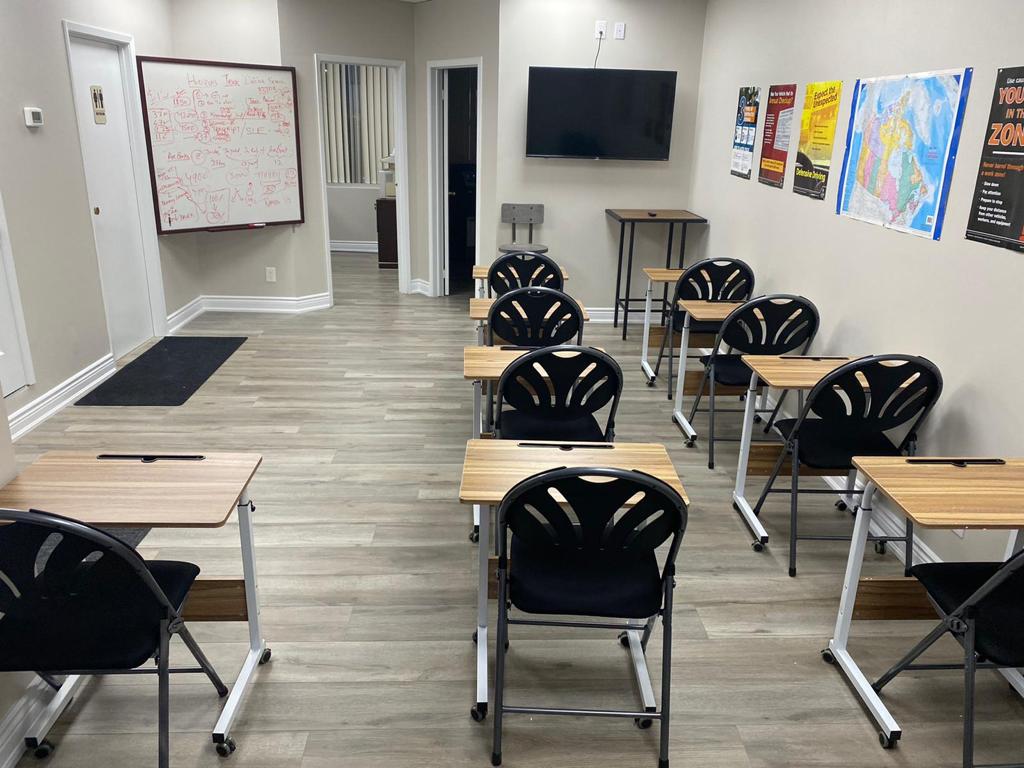
Our MELT program dedicates 12 hours to air brake instruction, both in the classroom and at the truck. By the time you sit your road test, the test sequence becomes second nature, and more importantly, you'll understand what's happening every time you press the pedal.